
What are the red flags when hiring a contractor?
The biggest red flags are no verifiable license number, a status that isn't Active, a demand for a large cash deposit up front, no written contract, and pressure to decide immediately. Start by confirming an Active CSLB license in the right classification; most contractor scams fail that first check.
Verified against CSLB on · reflects current CSLB rules and California law.
Summary — key takeaways
- No verifiable license number, or one that doesn't match the name on CSLB.
- A status that isn't Active: expired, suspended, or inactive.
- Large upfront or cash-only payments: California caps home-improvement deposits at 10% or $1,000, whichever is less.
- No written contract, or no proof of bond and insurance.
- A workers' comp exemption from a roofing, HVAC, concrete, asbestos, or C-61/D-49 tree service contractor: those classifications can't use one.
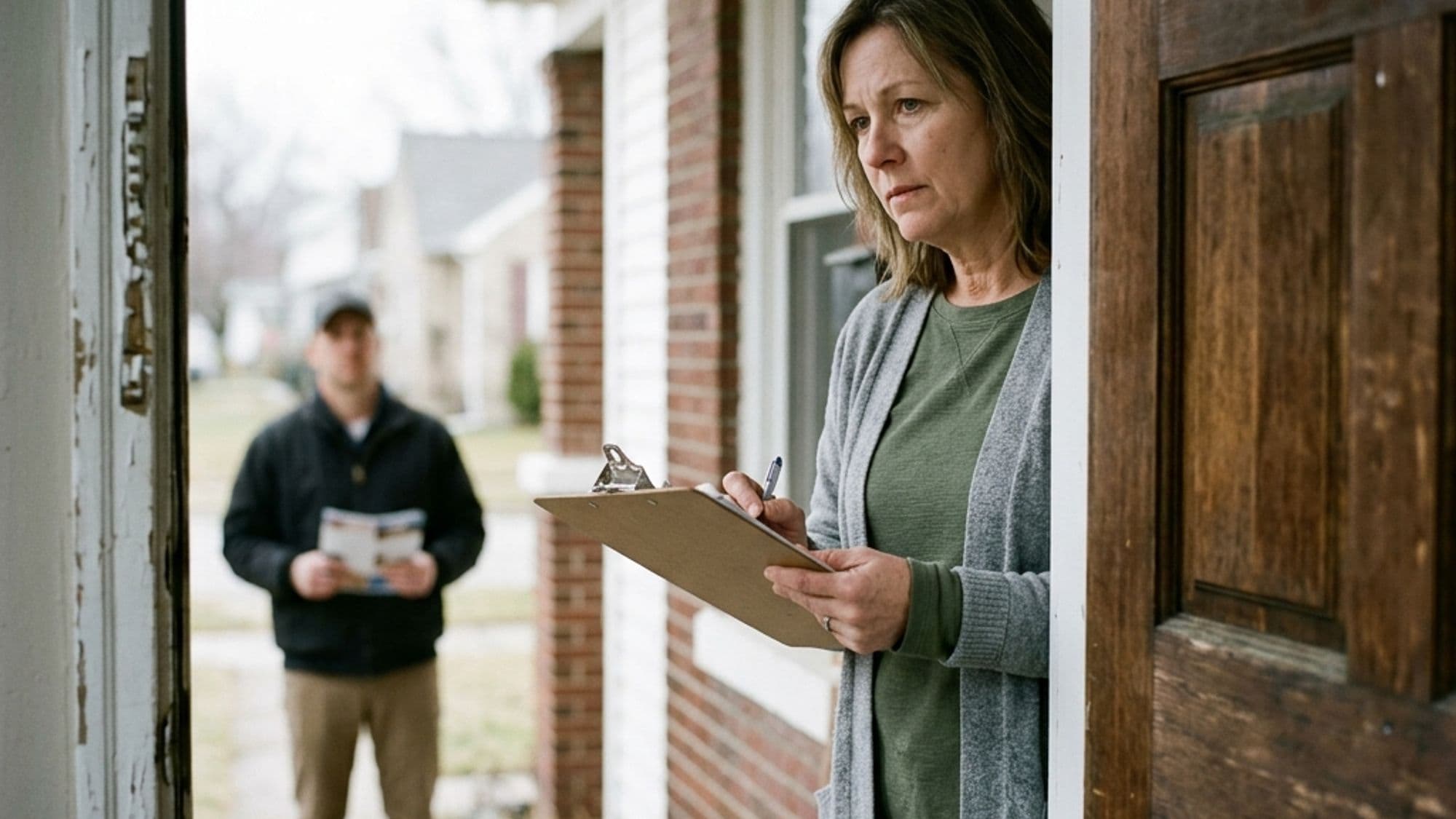
- High-pressure "today only" offers and post-storm door-to-door solicitation.
License red flags
Watch the license first: a contractor who won't give a license number, gives one that doesn't match their name on CSLB (or isn't six or seven digits), or whose status is expired, suspended, or inactive. California licensees must put their license number on contracts, bids, and ads.
Money and paperwork red flags
Watch the money and the paperwork: a large upfront payment (California caps a home-improvement down payment at 10% of the contract price or $1,000, whichever is less, under Business & Professions Code §7159), cash-only terms, no written contract, or no proof of bond and insurance. High-pressure 'today only' offers and door-to-door solicitation after a storm are classic warning signs.
Other warning signs
Watch the details: no physical address, a phone number that's always a voicemail, refusal to pull permits in your name, or reviews that don't match the business. Verify the license and ask for references before any money changes hands.
Insurance red flags
Watch the insurance. A roofing, HVAC, concrete, asbestos, or C-61/D-49 tree service contractor whose license record shows a workers' comp exemption is a red flag: those classifications must carry coverage even with no employees. An exemption on file plus a multi-person crew at your door doesn't add up either, because the exemption is only valid with zero employees. And a contractor who won't provide a certificate of liability insurance, or offers only a photocopy the insurer can't confirm, is asking you to carry the risk.
Frequently asked questions
How much deposit can a California contractor ask for?
For home-improvement work, the down payment is capped at 10% of the contract price or $1,000, whichever is less. A demand for much more up front, or for cash only, is a red flag.
What's the first thing to check before hiring a contractor?
The license. Confirm an Active CSLB license in the classification that matches your project, held by the business you're hiring. Most contractor scams fail this first check.
Is a cash-only contractor a red flag?
Yes. Cash-only terms, large upfront deposits, and no written contract are common warning signs. Insist on a written contract, a verifiable license, and proof of bond and insurance.
Is a workers' comp exemption a red flag?
It depends on the trade and the crew. C-8 concrete, C-20 HVAC, C-22 asbestos, C-39 roofing, and C-61/D-49 tree service contractors can't use the exemption at all, so seeing one there is disqualifying. For any other trade, an exemption is only legitimate if the contractor truly works alone; if a crew shows up, the exemption doesn't cover them.
Verify a contractor