
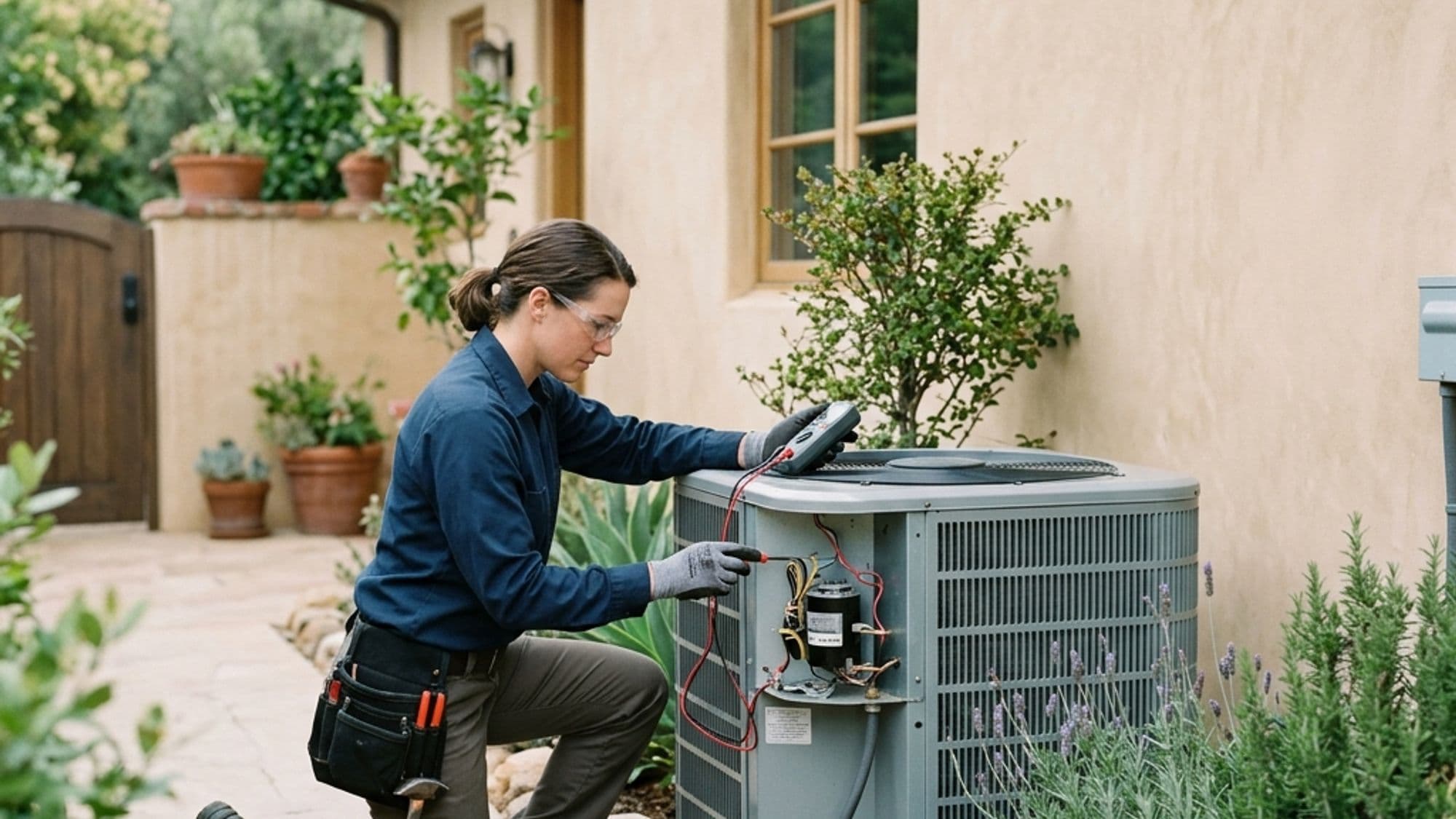
California C-20 HVAC Contractor License: Scope, Verification, and Workers' Comp
The C-20 license is the California classification for warm-air heating, ventilating, and air-conditioning (HVAC) contractors. A C-20 contractor is authorized to fabricate, install, maintain, service, and repair HVAC systems. Any HVAC job priced at $1,000 or more (labor, materials, and all other items) requires a licensed contractor, and a changeout that needs a permit requires one at any price. Under Senate Bill 216, C-20 contractors must carry workers' compensation insurance regardless of whether they have employees.
Verified against CSLB on · reflects current CSLB rules and California law.
Summary — key takeaways
- C-20 is the CSLB classification for HVAC (warm-air heating, ventilating, air-conditioning) contractors.
- It covers installing, servicing, and repairing HVAC systems and their components.
- HVAC work of $1,000 or more (labor, materials, and all other items) requires a licensed contractor (AB 2622, effective January 1, 2025).
- Furnace and AC changeouts usually need a permit, which removes the under-$1,000 exemption.
- Under SB 216, C-20 contractors must carry workers' comp regardless of employees.
- Verify a contractor's C-20 is Active on CSLB or in this directory before hiring.
What a C-20 HVAC license permits
The C-20 classification covers warm-air heating, ventilating, and air-conditioning systems: fabricating, installing, maintaining, servicing, testing, and repairing systems that produce, distribute, or control conditioned air. That includes furnaces, heat pumps, air conditioners, ductwork, and the related controls.
Work outside the HVAC system can require a different classification (for example C-10 for the electrical service feeding the equipment, or C-38 for commercial refrigeration), or a B General Building license where the project spans at least two unrelated trades.
What HVAC work legally requires a licensed contractor
Any HVAC project priced at $1,000 or more, counting labor, materials, and all other items, must be performed by a CSLB-licensed contractor. The threshold rose from $500 to $1,000 on January 1, 2025 under Assembly Bill 2622 (Business & Professions Code §7048); older pages that still say $500 are out of date.
HVAC changeouts and installations also typically require a building or mechanical permit from your city or county, which a licensed contractor pulls in their own name. That closes the small-job loophole: the under-$1,000 minor-work exemption is unavailable whenever the work requires a permit of any kind, and it also requires that the work is casual and minor, that the person works alone on the job, that it isn't part of a larger project, and that their advertising discloses they aren't licensed.
How to verify a C-20 HVAC contractor
Confirm the license is Active and the C-20 classification is listed, either on the CSLB "Check a License" tool or on the contractor's profile in this directory. CSLB license numbers are 6 or 7 digits, and searching by number is the most reliable route. If you only have a name, enter an individual's last name first, try the company name with and without spaces, and drop a leading "The" or "A".
Only an Active status authorizes new work; expired, suspended, inactive, or revoked does not. Match the license to the business you're hiring, check the $25,000 contractor bond is on file (Business & Professions Code §7071.6), and confirm workers' compensation coverage. The license belongs to the company through its qualifying individual (an RMO or RME); the technicians themselves are not individually licensed by CSLB.
You can browse Active C-20 HVAC contractors by city in the California HVAC directory and see each one's dated CSLB status before you hire.
The HVAC workers' compensation rule (SB 216)
Under Senate Bill 216, effective January 1, 2023, C-20 HVAC contractors must carry workers' compensation insurance (or approved self-insurance) regardless of whether they have employees. The same no-exemption rule covers C-8 Concrete, C-22 Asbestos Abatement, and C-61/D-49 Tree Service, and already applied to C-39 Roofing. A C-20 contractor cannot file the no-employee exemption that some other trades can still use.
Enforcement has teeth: since January 1, 2026, Senate Bill 291 sets minimum penalties of $10,000 per violation (sole owner) or $20,000 per violation (partnership, corporation, or LLC) for employing workers without coverage, and blocks license renewal or reinstatement without it. Senate Bill 1455 then makes workers' comp universal for every classification on January 1, 2028. Confirm a C-20 contractor's coverage shows on the CSLB record before hiring.
Frequently asked questions
What does a C-20 HVAC license cover?
Fabricating, installing, maintaining, servicing, and repairing warm-air heating, ventilating, and air-conditioning systems: furnaces, heat pumps, air conditioners, ductwork, and related controls. Electrical or refrigeration work outside the system can need a different classification.
Does an HVAC contractor need workers' comp in California?
Yes. Under Senate Bill 216, C-20 HVAC contractors must carry workers' compensation insurance regardless of whether they have employees, and from January 1, 2028 every California licensee must. Confirm coverage shows on the CSLB record before hiring.
How do I check if an HVAC contractor is licensed in California?
Look up the license on the CSLB "Check a License" tool or in this directory and confirm it reads Active with the C-20 classification, held by the business you're hiring. License numbers are 6 or 7 digits, so search by number when you have it.
What's the difference between a C-20 and a C-38 license?
C-20 covers warm-air heating, ventilating, and air-conditioning systems. C-38 covers refrigeration: commercial and industrial refrigeration systems. Choose the classification that matches the equipment being worked on.
Do I need a permit to replace a furnace or air conditioner in California?
Usually yes. Most cities and counties require a mechanical or building permit for equipment changeouts, and the licensed contractor should pull it in their own name. Check with your local building department, and be wary of anyone who proposes skipping the permit.
Do HVAC technicians need their own individual licenses?
No. CSLB licenses the HVAC business through its qualifying individual (an RMO or RME); the technicians who show up are not individually licensed by CSLB. What matters is that the company's C-20 is Active and its insurance is current.
Can a handyman do a small HVAC repair without a license?
Only if the total price (labor, materials, and all other items) is under $1,000, the work is casual and minor, requires no permit of any kind, the person works alone, the job isn't part of a larger project, and their advertising discloses they aren't licensed. A repair that triggers a permit requires a licensed contractor regardless of price.
Verify a contractor
Related guides and questions
Sources
- CSLB: Check a License
- California Business & Professions Code §7048 (AB 2622, $1,000 threshold)
- California Business & Professions Code §7125 (workers' compensation)
- California Business & Professions Code §7125.4 (workers' comp penalties, SB 291)
- California Business & Professions Code §7071.6 (contractor bond)