California C-10 Electrical Contractor License: Scope, Verification, and the Two Credentials to Check
The C-10 license is the California classification for electrical contractors: the businesses that install, alter, and repair wiring, panels, fixtures, and any system that generates, transmits, transforms, or uses electrical energy, including solar photovoltaic and battery storage. Any electrical job where labor, materials, and all other items total $1,000 or more must be done by a licensed contractor. California regulates electrical work through two separate credentials: the CSLB C-10 license for the contracting business, and a DIR electrician certification for the individual worker. A complete check covers both.
Verified against CSLB on · reflects current CSLB rules and California law.
Summary — key takeaways
- C-10 is the CSLB classification for electrical contractors.
- California has TWO electrical credentials: the CSLB C-10 licenses the business; the DIR Electrician Certification covers the individual worker. Check both.
- There is no California 'journeyman electrician license': the state issues electrician certifications and trainee registrations through DIR, not journeyman licenses.
- A C-10 may install solar PV and battery storage (BESS) with no size cap; a C-46 solar contractor's battery authority is limited to 80 kWh alongside its own solar installs.
- Electrical work of $1,000+ (labor, materials, and all other items) requires a licensed contractor (AB 2622, 2025).
What a C-10 electrical license permits
The C-10 classification covers electrical work: wiring, raceways, fixtures, panels, and the systems that generate, transmit, transform, or use electrical energy. That scope includes solar photovoltaic (PV) systems and battery energy storage systems (BESS), with no size cap or special conditions attached to the C-10.
That breadth is why the C-10 is the safe credential for a solar-plus-battery project. A C-46 solar contractor's battery authority is much narrower: under a February 2026 legal settlement, a C-46 may install and service batteries up to 80 kWh only alongside solar systems it installs or originally installed. Standalone battery retrofits, batteries added to another company's system, and systems of 80 kWh or more require a C-10 (or an A or B licensee acting within its own scope).
The two credentials: CSLB C-10 vs. DIR certification
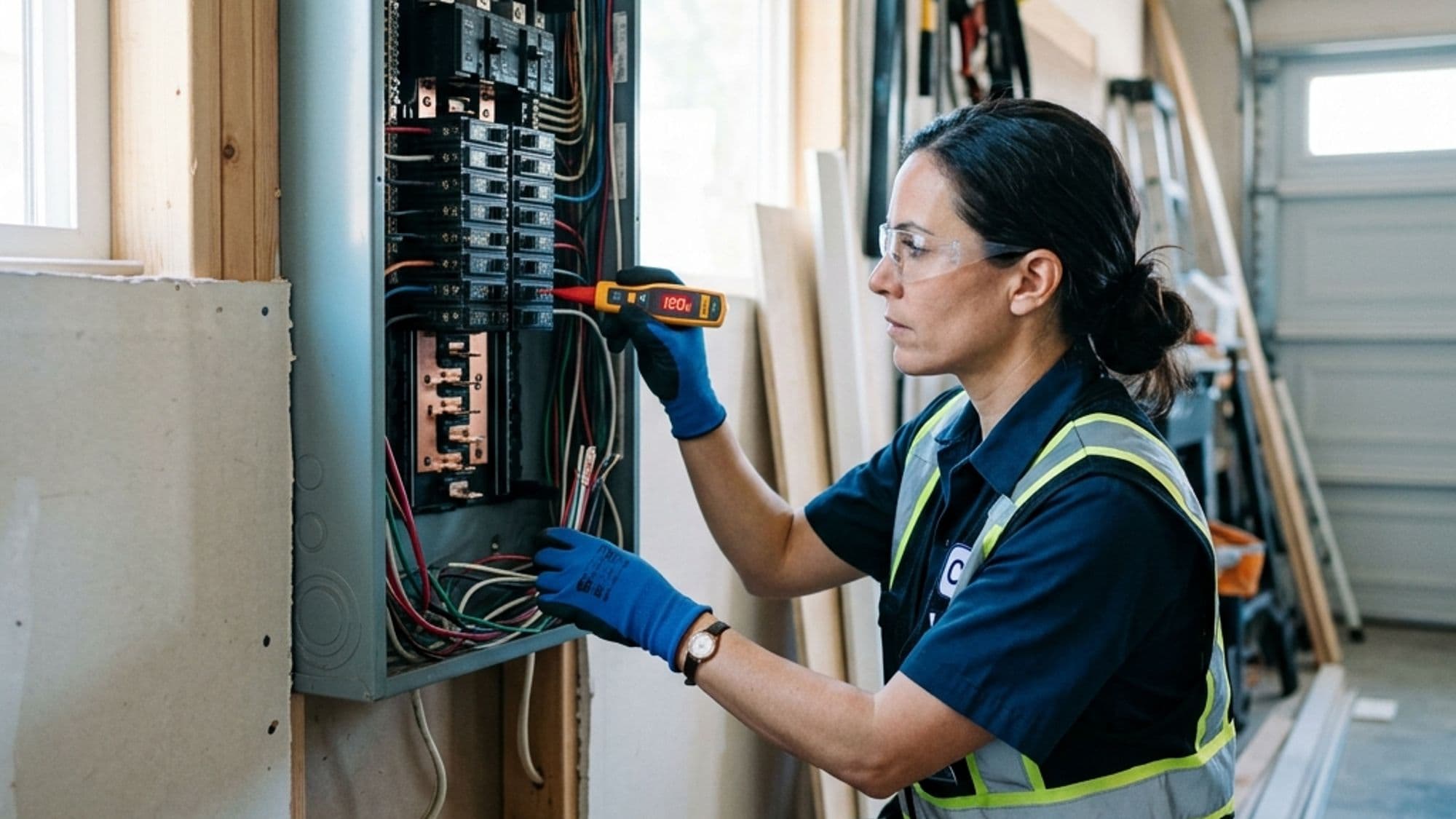
California splits electrical regulation across two agencies. CSLB licenses the C-10 contracting business. The Department of Industrial Relations (DIR), through the Labor Commissioner's Electrician Certification Unit, certifies the individual electricians who perform electrical work for C-10 contractors. There are five certification categories (General Electrician, Residential Electrician, Fire/Life Safety Technician, Voice Data Video Technician, and Non-Residential Lighting Technician), and uncertified workers must generally be registered apprentices or registered trainees working under a certified electrician's supervision.
There is no California 'journeyman electrician license' to look up: the state issues electrician certifications and trainee registrations, not journeyman licenses. If a search sends you hunting for a journeyman license lookup, that's why you can't find one. You can verify a worker's credential through the DIR's Electrician Certification Search, which works from the certification or trainee number rather than a free-text name search, so ask the electrician for their number.
What electrical work legally requires a licensed contractor
Any project where labor, materials, and all other items total $1,000 or more must be performed by a CSLB-licensed contractor. The threshold rose from $500 to $1,000 on January 1, 2025 under Assembly Bill 2622 (Business & Professions Code §7048). Below $1,000, a narrow minor-work exemption can apply only if the job is casual, minor, and standalone (not part of a larger project), requires no building permit of any kind, no one is employed on the job, and any advertising discloses that the person is not licensed.
Panel upgrades, new circuits, and service changes also require a permit, which a licensed contractor pulls in their own name. For anything beyond a minor repair, look for an Active C-10 (or a B General Building license where the scope qualifies).
How to verify a C-10 electrical contractor
Confirm the license is Active and the C-10 classification is listed, either on the CSLB "Check a License" tool or on the contractor's profile in this directory. CSLB license numbers are six or seven digits; match the number and the business name to your contract and bid. Check that the $25,000 contractor bond is on file (Business & Professions Code §7071.6) and that workers' compensation coverage, or a valid exemption, is shown.
For the workers doing the job, you can separately confirm individual certification through the DIR's Electrician Certification Search (have the worker's certification or trainee number ready). Browse Active C-10 electrical contractors by city in the California electrical directory and see each one's dated CSLB status before you hire.
The electrical workers' compensation rule
A electrical contractor must carry workers' compensation insurance for any employees. A contractor that genuinely works alone can currently file a no-employee exemption, so the CSLB record may show an exemption rather than a policy: confirm one or the other before you hire. Since January 1, 2026 (SB 291), a licensee caught employing workers without coverage faces minimum penalties of $10,000 per violation for a sole owner and $20,000 per violation for a partnership, corporation, or LLC, and cannot renew without current coverage.
Senate Bill 1455 will extend that requirement to every CSLB licensee, regardless of employees, on January 1, 2028, with CSLB's exemption-verification process due by January 1, 2027. Five high-risk classifications already carry no exemption at all, C-8 (concrete), C-20 (HVAC), C-22 (asbestos abatement), C-39 (roofing), and C-61/D-49 (tree service), and must hold coverage regardless of employees.
Frequently asked questions
How do you check if an electrician is licensed in California?
Look up the contracting business on the CSLB "Check a License" tool or in this directory and confirm it reads Active with the C-10 classification. For the individual workers, ask for their DIR electrician certification or trainee number and verify it through the DIR's Electrician Certification Search.
Do electricians have to be licensed in California?
The contracting business must hold a CSLB C-10 (or qualifying B) license for any electrical job of $1,000 or more, and the individual electricians a C-10 employs must be DIR-certified, registered apprentices, or supervised registered trainees. Both credentials apply.
Is there a California journeyman electrician license lookup?
No. California does not issue a 'journeyman electrician license.' The state issues electrician certifications and trainee registrations through DIR, and contractor licenses (C-10) through CSLB: those are the two credentials to verify.
Do solar installers need a C-10 or a C-46 in California?
Either can install solar PV. For battery storage, the C-10 has full authority; a C-46 may install batteries up to 80 kWh, and only alongside solar systems it installs or originally installed. For a standalone battery retrofit or a system of 80 kWh or more, confirm the C-10 (or an A or B licensee within its scope).
How do I verify an individual electrician's certification in California?
Use the DIR's Electrician Certification Search, run by the Labor Commissioner's Electrician Certification Unit. It works from the electrician's certification number or trainee number rather than a free-text name search, so ask the worker for their number and check it before work begins.
Does every worker on an electrical job need to be certified in California?
Workers performing electrical work for a C-10 contractor must be DIR-certified electricians, registered apprentices in an approved program, or registered trainees supervised by a certified electrician. The C-10 qualifier on the contractor license is a separate, business-level credential.
Verify a contractor
Related guides and questions
Sources
- CSLB: Check a License
- CSLB: Description of License Classifications (PDF)
- California DIR: Electrician Certification Unit
- California DIR: Electrician Certification Search
- CSLB Solar Smart: classifications authorized for solar work
- California Business & Professions Code §7048 (AB 2622, $1,000 threshold)
- California Business & Professions Code §7125 (workers' compensation)