California C-46 Solar Contractor License: Scope, Verification, and Spotting Solar Scams
The C-46 license is the California classification for solar contractors, covering both thermal and photovoltaic solar energy systems. Photovoltaic (electric) solar can also legally be installed under an A, B (on a qualifying multi-trade project), or C-10 license, so the first defense against a solar scam is confirming that the exact company on your contract holds a current CSLB license covering the work. Battery storage is more restricted: a C-46 may install batteries up to 80 kWh, and only alongside solar systems it installs or originally installed.
Verified against CSLB on · reflects current CSLB rules and California law.
Summary — key takeaways
- C-46 is the CSLB classification for solar (thermal and photovoltaic) contractors.
- Photovoltaic solar may be installed under A, B, C-10, or C-46; C-4, C-36, and C-53 cover solar thermal and water-heating work only.
- C-46 battery authority is limited: up to 80 kWh, and only alongside the C-46's own solar installs. Standalone battery work requires a C-10 (or an A or B within its scope).
- NABCEP is a voluntary certification, not a CSLB license.
- Verifying the license against the exact company name on your contract is the first step to spotting a solar scam.
What a C-46 solar license permits
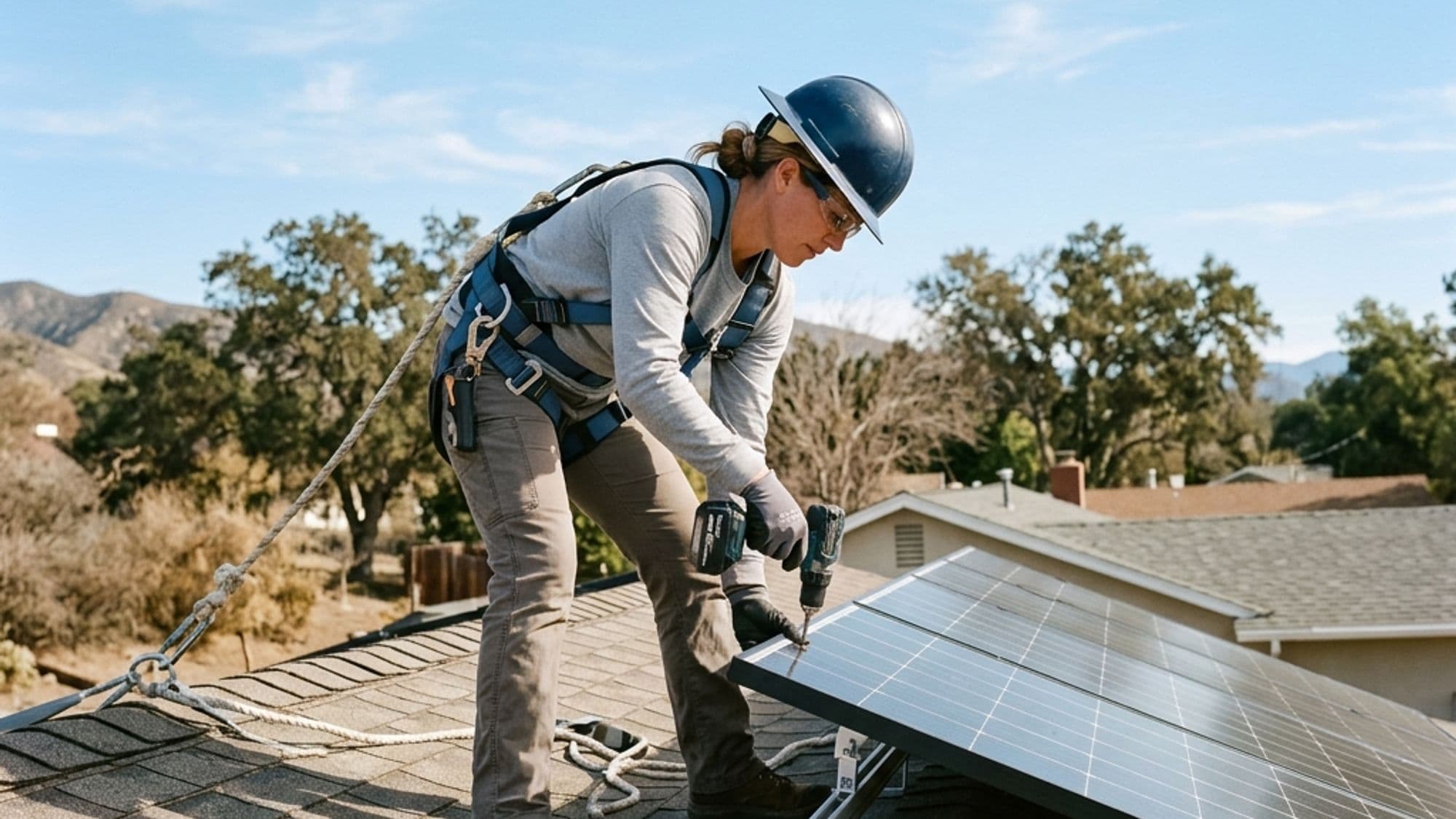
The C-46 classification covers installing, modifying, maintaining, and repairing thermal and photovoltaic solar energy systems: the panels, mounting, and related components that convert sunlight to heat or electricity. A C-46 may not perform other building trades except as required to install the solar system.
Solar isn't exclusive to C-46. Per CSLB's Solar Smart guidance, photovoltaic systems can be installed under an A (general engineering), B (general building, on a project involving two or more unrelated trades), C-10 (electrical), or C-46 license. C-4, C-36, and C-53 also appear on CSLB's solar list, but only for solar thermal and water-heating work (boilers, plumbing, and pool heating), not photovoltaic panels. What matters is that whoever signs your contract holds a current license that covers your specific project.
C-46 vs. C-10, and battery storage
California's battery rules are in flux, so be precise here. CSLB adopted a battery energy storage (BESS) regulation in 2024, but a court order has stayed it, and a February 2026 settlement now frames what a C-46 can do: install and service batteries up to 80 kWh, and only as part of a new solar system it installs, as an addition to a solar system it originally installed, or as maintenance on batteries it installed. Standalone battery retrofits, batteries added to another company's system, and systems over 80 kWh require a C-10 electrical contractor (or an A or B licensee acting within its own scope). The rules may be refined again, so check CSLB's current guidance for the latest.
In practice: if your quote pairs panels with a battery under 80 kWh from the same installer, a C-46 can be legitimate. If the quote is a battery-only retrofit, a battery added to a system someone else installed, or a larger system, confirm the C-10. NABCEP (the North American Board of Certified Energy Practitioners) is a respected voluntary certification, but it is not a CSLB license and does not authorize contracting on its own. Verify the CSLB license first.
What solar work legally requires a licensed contractor
Any project where labor, materials, and all other items total $1,000 or more must be performed by a CSLB-licensed contractor. The threshold rose from $500 to $1,000 on January 1, 2025 under Assembly Bill 2622 (Business & Professions Code §7048). Below $1,000, a narrow minor-work exemption can apply only if the job is casual, minor, and standalone (not part of a larger project), requires no building permit of any kind, no one is employed on the job, and any advertising discloses that the person is not licensed.
A residential solar installation is virtually always well above $1,000, so it must be done by a licensed contractor, and the installation requires permits and utility interconnection that a licensed contractor handles. There is no DIY-scale exemption for a real rooftop system.
Verify the license before you sign, and spot the scam
Confirm the license is Active and that a classification covering your project is listed: C-46 or C-10 for panels (an A or B can also qualify), and C-10 (or an A or B within its scope) for standalone battery work. Check it on the CSLB "Check a License" tool or on the contractor's profile in this directory, and match the license to the exact business on your contract: door-to-door solar sellers often quote under a marketing name that doesn't match any license. Check that the $25,000 contractor bond is on file (Business & Professions Code §7071.6) and that workers' compensation coverage, or a valid exemption, is shown.
Solar draws high-pressure sales: a legitimate company will let you verify the license before signing. Be wary of 'today only' pricing, large upfront deposits, vague company names that don't match the license, and promises that gloss over permits or utility interconnection. Verifying the CSLB record is the single fastest way to separate a real installer from a scam.
The solar workers' compensation rule
A solar contractor must carry workers' compensation insurance for any employees. A contractor that genuinely works alone can currently file a no-employee exemption, so the CSLB record may show an exemption rather than a policy: confirm one or the other before you hire. Since January 1, 2026 (SB 291), a licensee caught employing workers without coverage faces minimum penalties of $10,000 per violation for a sole owner and $20,000 per violation for a partnership, corporation, or LLC, and cannot renew without current coverage.
Senate Bill 1455 will extend that requirement to every CSLB licensee, regardless of employees, on January 1, 2028, with CSLB's exemption-verification process due by January 1, 2027. Five high-risk classifications already carry no exemption at all, C-8 (concrete), C-20 (HVAC), C-22 (asbestos abatement), C-39 (roofing), and C-61/D-49 (tree service), and must hold coverage regardless of employees.
Frequently asked questions
How do I verify a solar contractor in California?
Look up the business on the CSLB "Check a License" tool or in this directory and confirm it reads Active with a classification that covers the work (C-46 or C-10 for panels), held by the exact company on your contract. Then confirm the bond and workers' compensation.
Is my solar company licensed in California?
Check the CSLB record for the company name on your quote: an Active license with C-46 or C-10 (or an A or B on a qualifying project) covers photovoltaic solar. If you can't find a matching record, treat the company as unverified and don't sign.
What license do solar installers need in California, C-46 or C-10?
Either can install solar panels. For batteries, a C-46 is limited to systems up to 80 kWh installed alongside its own solar work; standalone battery retrofits and systems of 80 kWh or more require a C-10 (or an A or B within its scope). For a solar-plus-storage quote, ask which license covers the battery.
How do I spot a solar scam before signing in California?
Verify the CSLB license first. Then watch for high-pressure 'today only' pricing, large upfront deposits, a company name that doesn't match the license, and promises that skip over permits and utility interconnection.
Can a C-46 solar contractor install my home battery in California?
Only in limited cases: up to 80 kWh, and only as part of a solar system the C-46 installs, adds to, or maintains itself, under a February 2026 settlement reached while CSLB's 2024 battery regulation is stayed by court order. A battery-only retrofit, a battery on another company's system, or a system of 80 kWh or more needs a C-10 (or an A or B within its scope).
Verify a contractor
Related guides and questions
- California C-10 electrical contractor license guide
- How to avoid contractor scams in California
- What are the red flags when hiring a contractor?
- Licensed vs. unlicensed contractor: what work needs a license in California
- Licensed vs. bonded vs. insured: what's the difference?
- How do I verify a California contractor's license?
Sources
- CSLB: Check a License
- CSLB: Description of License Classifications (PDF)
- CSLB Solar Smart: classifications authorized for solar work
- California Business & Professions Code §7058 (specialty contractor)
- California Business & Professions Code §7048 (AB 2622, $1,000 threshold)
- California Business & Professions Code §7125 (workers' compensation)