
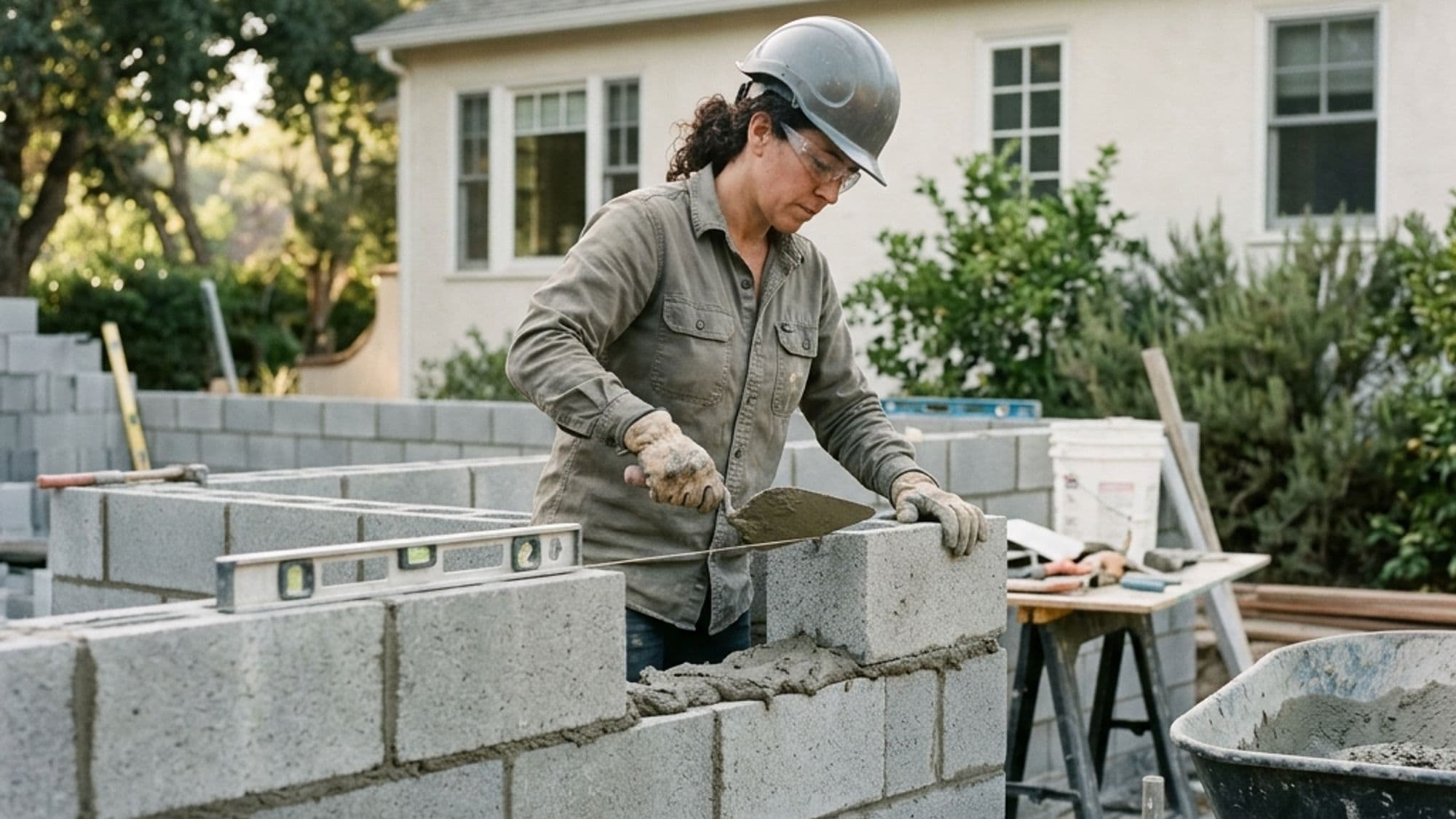
California C-29 Masonry Contractor License: Scope, Verification, and Unlicensed-Work Limits
The C-29 license is the California classification for masonry contractors: block, brick, stone, and concrete-masonry-unit walls, masonry fences, pavers, and masonry waterproofing. Any masonry job where labor, materials, and all other items total $1,000 or more must be done by a licensed contractor. Below that, a person can do only casual minor work: no permit, no one employed on the job, not part of a larger project, and with disclosure that they aren't licensed.
Verified against CSLB on · reflects current CSLB rules and California law.
Summary — key takeaways
- C-29 is the CSLB classification for masonry contractors.
- It covers block, brick, stone, and CMU walls, masonry fences, pavers, and masonry waterproofing.
- Masonry overlaps C-8 (concrete), C-27 (landscape pavers), and C-13 (fences without masonry).
- Masonry work of $1,000+ (labor, materials, and all other items) requires a licensed contractor (AB 2622, 2025).
- An unlicensed mason may legally take only sub-$1,000 minor jobs, with disclosure.
What a C-29 masonry license permits
The C-29 classification covers masonry: concrete units (CMU/block), brick, stone, terra cotta, and similar units laid in mortar, in structural and non-structural walls, masonry fences and planters, pavers set in or on a masonry base, and masonry waterproofing.
It overlaps neighboring trades: poured concrete flatwork is C-8, landscape pavers can fall under C-27, and a fence with no masonry is C-13. For a job that mixes, say, a poured footing and a block wall, confirm the contractor's classifications cover the actual work.
How masonry overlaps concrete, pavers, and fencing
Block and brick walls, stone veneer, and mortar-set pavers are C-29 work. Poured concrete driveways, patios, and slabs are C-8 concrete. Pavers installed as part of a landscape can be C-27. A fence built without masonry (wood, vinyl, chain-link, or iron) is C-13, not C-29.
These overlaps are why 'who do I hire' is confusing for hardscape. The safe move is to read the contractor's CSLB classifications and match them to your specific job.
What masonry work legally requires a licensed contractor
Any project where labor, materials, and all other items total $1,000 or more must be performed by a CSLB-licensed contractor. The threshold rose from $500 to $1,000 on January 1, 2025 under Assembly Bill 2622 (Business & Professions Code §7048). Below $1,000, a narrow minor-work exemption can apply only if the job is casual, minor, and standalone (not part of a larger project), requires no building permit of any kind, no one is employed on the job, and any advertising discloses that the person is not licensed.
An unlicensed person may legally perform only minor masonry work under $1,000 in labor, materials, and all other items, and only if it isn't part of a larger project, no one is employed on the job, and they disclose they aren't licensed. Contracting at or above $1,000 without a license is a misdemeanor (Business & Professions Code §7028), so an unlicensed mason quoting a $4,000 patio wall is the red flag, not the bargain.
How to verify a C-29 masonry contractor
Confirm the license is Active and the C-29 classification is listed, either on the CSLB "Check a License" tool or on the contractor's profile in this directory. Match the license to the business you're hiring. Check that the $25,000 contractor bond is on file (Business & Professions Code §7071.6) and that workers' compensation coverage, or a valid exemption, is shown.
Browse Active C-29 masonry contractors by city in the California masonry directory and see each one's dated CSLB status before you hire.
The masonry workers' compensation rule
A masonry contractor must carry workers' compensation insurance for any employees. A contractor that genuinely works alone can currently file a no-employee exemption, so the CSLB record may show an exemption rather than a policy: confirm one or the other before you hire. Since January 1, 2026 (SB 291), a licensee caught employing workers without coverage faces minimum penalties of $10,000 per violation for a sole owner and $20,000 per violation for a partnership, corporation, or LLC, and cannot renew without current coverage.
Senate Bill 1455 will extend that requirement to every CSLB licensee, regardless of employees, on January 1, 2028, with CSLB's exemption-verification process due by January 1, 2027. Five high-risk classifications already carry no exemption at all, C-8 (concrete), C-20 (HVAC), C-22 (asbestos abatement), C-39 (roofing), and C-61/D-49 (tree service), and must hold coverage regardless of employees.
Frequently asked questions
Do I need a licensed masonry contractor for a small job in California?
Only masonry work under $1,000 in labor, materials, and all other items can be done unlicensed, and only with disclosure and if it isn't part of a larger project. At or above $1,000, hire an Active C-29 contractor.
How much can an unlicensed mason charge in California?
An unlicensed person may legally take only minor jobs under $1,000 in labor, materials, and all other items. Contracting at or above that threshold without a license is a misdemeanor under Business & Professions Code §7028, and if you've already paid an unlicensed mason, §7031(b) lets you sue to recover all compensation paid, regardless of the work's quality.
Does a general (B) contractor cover masonry work?
A B can perform masonry as part of a larger multi-trade project, but for a standalone masonry job it needs the C-29 classification or must subcontract the work to a licensed C-29 mason.
What license does a paver or block-wall contractor need in California?
Masonry block and brick walls and mortar-set pavers are C-29 work. Landscape pavers can fall under C-27, and poured concrete is C-8: match the contractor's classifications to your job.
Verify a contractor
Related guides and questions
- What are the risks of hiring an unlicensed contractor?
- Licensed vs. unlicensed contractor: what work needs a license in California
- Licensed vs. bonded vs. insured: what's the difference?
- What is the $25,000 California contractor bond?
- California C-8 concrete contractor license guide
- How do I verify a California contractor's license?
Sources
- CSLB: Check a License
- CSLB: Description of License Classifications (PDF)
- California Business & Professions Code §7048 (AB 2622, $1,000 threshold)
- California Business & Professions Code §7028 (unlicensed contracting)
- California Business & Professions Code §7031 (recovering money paid to an unlicensed contractor)
- California Business & Professions Code §7071.6 (contractor bond)