
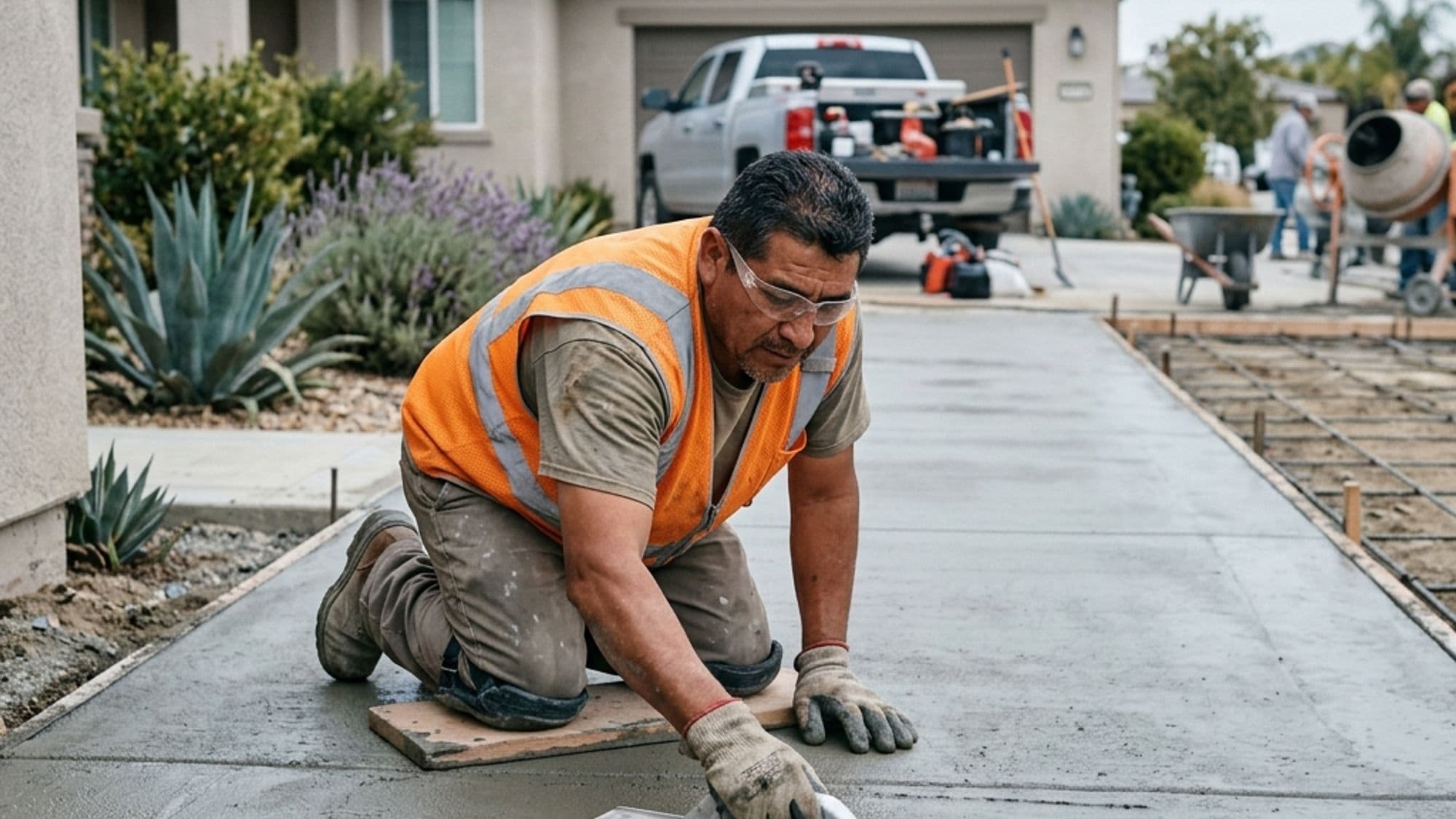
California C-8 Concrete Contractor License: Scope, Verification, and Workers' Comp
The C-8 license is the California classification for concrete contractors: forming, pouring, and finishing concrete flatwork (driveways, patios, slabs) and mass concrete. Any concrete job where labor, materials, and all other items total $1,000 or more must be done by a licensed contractor, and C-8 is one of only five classifications whose contractors must carry workers' compensation regardless of employees.
Verified against CSLB on · reflects current CSLB rules and California law.
Summary — key takeaways
- C-8 is the CSLB classification for concrete contractors.
- It covers forming, pouring, and finishing concrete flatwork and mass concrete: driveways, patios, and slabs.
- Asphalt paving is C-12, not C-8; pavers are C-29 or C-27.
- Concrete work of $1,000+ (labor, materials, and all other items) requires a licensed contractor (AB 2622, 2025).
- C-8 is one of only five no-exemption classifications: a concrete contractor must carry workers' comp regardless of employees.
What a C-8 concrete license permits
The C-8 classification covers forming, placing, and finishing concrete: flatwork such as driveways, patios, walkways, and slabs, as well as mass concrete like footings and foundations.
It excludes work that belongs to neighboring trades: a concrete contractor doesn't perform sole plastering or set the reinforcing steel as a separate trade, an asphalt driveway is C-12 (earthwork and paving), and pavers fall under C-29 (masonry) or C-27 (landscaping). Match the classification to the surface you're installing.
What concrete work legally requires a licensed contractor
Any project where labor, materials, and all other items total $1,000 or more must be performed by a CSLB-licensed contractor. The threshold rose from $500 to $1,000 on January 1, 2025 under Assembly Bill 2622 (Business & Professions Code §7048). Below $1,000, a narrow minor-work exemption can apply only if the job is casual, minor, and standalone (not part of a larger project), requires no building permit of any kind, no one is employed on the job, and any advertising discloses that the person is not licensed.
A small concrete repair under $1,000 in labor, materials, and all other items can be unlicensed, with disclosure. A driveway replacement or patio pour is well over the threshold and should go to an Active C-8.
Permit vs. license for concrete work
Homeowners often ask whether they need a permit to pour concrete. The license and the permit are separate: the C-8 is the contractor's credential; a permit is the city's approval for the specific work. Many cities require a permit to replace a driveway in the public right-of-way or to pour structural concrete, even though a simple backyard slab sometimes doesn't.
Confirm both: an Active C-8 contractor, and whatever permit your city requires for the specific pour. A licensed contractor pulls the permit in their own name.
The concrete workers' compensation rule
C-8 concrete contractors must carry workers' compensation insurance regardless of whether they have employees. It is one of only five classifications, C-8 (concrete), C-20 (HVAC), C-22 (asbestos abatement), C-39 (roofing), and C-61/D-49 (tree service), whose contractors cannot claim the no-employee workers' compensation exemption. Senate Bill 216 phased in this regardless-of-employees requirement for these high-risk trades.
Senate Bill 1455 will extend that requirement to every CSLB licensee, regardless of employees, on January 1, 2028, with CSLB's exemption-verification process due by January 1, 2027. Since January 1, 2026 (SB 291), a licensee caught employing workers without coverage faces minimum penalties of $10,000 per violation for a sole owner and $20,000 for a partnership, corporation, or LLC, and cannot renew without current coverage. For concrete there is no no-employee exemption today: confirm a C-8 contractor's workers'-compensation coverage before hiring. Concrete work is physically hazardous, and if an uninsured worker is hurt on your property, you could be asked to pay through your homeowner's policy or face lawsuits.
How to verify a C-8 concrete contractor
Confirm the license is Active and the C-8 classification is listed, either on the CSLB "Check a License" tool or on the contractor's profile in this directory. Match the license to the business you're hiring. Check that the $25,000 contractor bond is on file (Business & Professions Code §7071.6) and that workers' compensation coverage, or a valid exemption, is shown.
Because C-8 carries no workers'-comp exemption, treat a missing coverage record as a reason to pause. Browse Active C-8 concrete contractors by city in the California concrete directory and see each one's dated CSLB status before you hire.
Frequently asked questions
Do you need a contractor license to pour concrete in California?
Any concrete job of $1,000 or more in labor, materials, and all other items must be done by a CSLB-licensed C-8 contractor. Smaller minor work can be unlicensed only with disclosure and if it isn't part of a larger project.
Do I need a permit to pour concrete or replace my driveway in California?
Often, yes: many cities require a permit to replace a driveway or pour structural concrete, separate from the contractor's C-8 license. A licensed contractor pulls the permit in their own name. Confirm your city's rule for the specific work.
What license does a concrete contractor need in California?
A C-8 concrete classification for flatwork and mass concrete. An asphalt driveway is C-12, and pavers are C-29 or C-27: match the classification to the surface.
Does a concrete contractor need workers' comp in California?
Yes. C-8 is one of only five classifications (with C-20, C-22, C-39, and C-61/D-49) whose contractors must carry workers' compensation regardless of employees: there is no no-employee exemption. Confirm coverage before hiring.
Verify a contractor
Related guides and questions
- Do California contractors need workers' compensation insurance?
- What are the risks of hiring an unlicensed contractor?
- Licensed vs. unlicensed contractor: what work needs a license in California
- Licensed vs. bonded vs. insured: what's the difference?
- California C-29 masonry contractor license guide
- How do I verify a California contractor's license?