
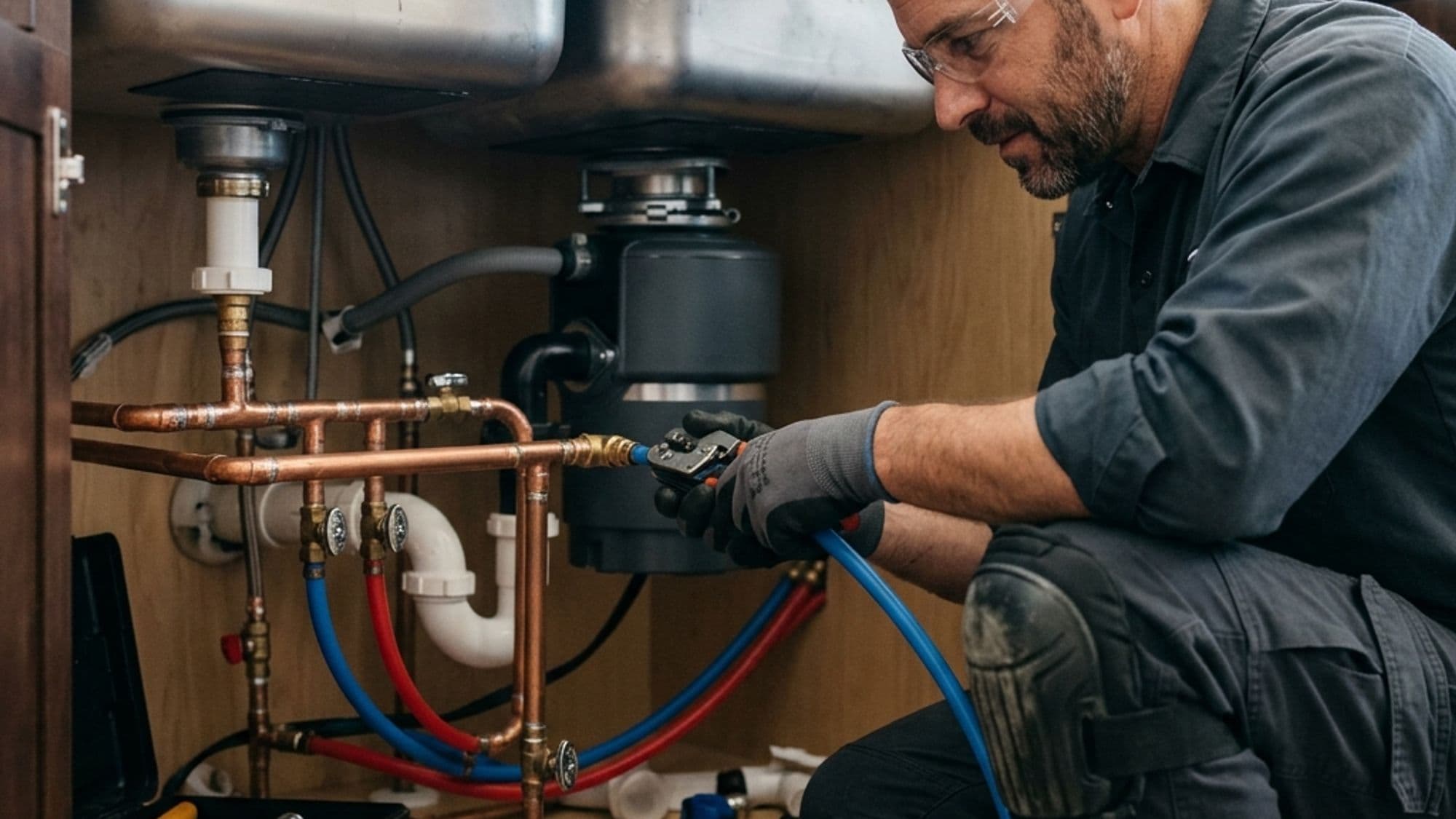
California C-36 Plumbing Contractor License: Scope, Verification, and Workers' Comp
The C-36 license is the California classification for plumbing contractors. A C-36 contractor is authorized to install and repair water supply, drainage and waste, gas piping, water heaters, backflow prevention, and water-conditioning systems. Any plumbing job where labor, materials, and all other items total $1,000 or more must be done by a licensed contractor. Individual employee plumbers don't need their own license; the company's qualifier holds the C-36.
Verified against CSLB on · reflects current CSLB rules and California law.
Summary — key takeaways
- C-36 is the CSLB classification for plumbing contractors.
- It covers water supply, waste and drainage, gas piping, water heaters, backflow, and water-conditioning installation.
- Plumbing work of $1,000+ (labor, materials, and all other items) requires a licensed contractor (AB 2622, 2025).
- Individual employee plumbers need not be licensed: the company's qualifier (RMO/RME) holds the C-36.
- Sewer work can fall under C-36, C-42, or C-34: confirm the classification matches the job.
What a C-36 plumbing license permits
The C-36 classification covers plumbing systems: water supply, drainage and waste, vent piping, gas piping, water heaters, backflow-prevention devices, and the installation of water-conditioning equipment (which overlaps the C-55 water-conditioning classification).
Sewer and sewer-line work can fall under C-36, the C-42 sanitation-system classification, or the C-34 pipeline classification depending on the job, so for a main sewer replacement, confirm the contractor's classification actually covers it.
What plumbing work legally requires a licensed contractor
Any project where labor, materials, and all other items total $1,000 or more must be performed by a CSLB-licensed contractor. The threshold rose from $500 to $1,000 on January 1, 2025 under Assembly Bill 2622 (Business & Professions Code §7048). Below $1,000, a narrow minor-work exemption can apply only if the job is casual, minor, and standalone (not part of a larger project), requires no building permit of any kind, no one is employed on the job, and any advertising discloses that the person is not licensed.
Water-heater changeouts, repipes, and sewer work typically also require a building permit, which a licensed contractor pulls in their own name. For anything beyond a minor repair, look specifically for an Active C-36 (or a B General Building license where the project spans at least two unrelated trades).
Are individual plumbers required to be licensed?
No. CSLB licenses the contracting business, not each worker: an employee plumber working for a licensed company does not need a personal license. The license is held through the company's qualifying individual (an RMO or RME).
So verify the business you're hiring, not the person who shows up: confirm the company holds an Active C-36 in the name on your contract and bid.
How to verify a C-36 plumbing contractor
Confirm the license is Active and the C-36 classification is listed, either on the CSLB "Check a License" tool or on the contractor's profile in this directory. Match the license to the business you're hiring. Check that the $25,000 contractor bond is on file (Business & Professions Code §7071.6) and that workers' compensation coverage, or a valid exemption, is shown.
You can browse Active C-36 plumbers by city in the California plumbing directory and see each one's dated CSLB status before you hire.
The plumbing workers' compensation rule
A plumbing contractor must carry workers' compensation insurance for any employees. A contractor that genuinely works alone can currently file a no-employee exemption, so the CSLB record may show an exemption rather than a policy: confirm one or the other before you hire. Since January 1, 2026 (SB 291), a licensee caught employing workers without coverage faces minimum penalties of $10,000 per violation for a sole owner and $20,000 per violation for a partnership, corporation, or LLC, and cannot renew without current coverage.
Senate Bill 1455 will extend that requirement to every CSLB licensee, regardless of employees, on January 1, 2028, with CSLB's exemption-verification process due by January 1, 2027. Five high-risk classifications already carry no exemption at all, C-8 (concrete), C-20 (HVAC), C-22 (asbestos abatement), C-39 (roofing), and C-61/D-49 (tree service), and must hold coverage regardless of employees.
Frequently asked questions
Does my plumber need a license in California?
Any plumbing job of $1,000 or more in labor, materials, and all other items must be done by a CSLB-licensed contractor holding a C-36 (or a B General Building license on a qualifying multi-trade project). Smaller minor work can be unlicensed only with disclosure.
What license should my plumber have in California?
A C-36 plumbing classification, shown as Active on the CSLB record. For a main sewer line, the work may instead fall under C-42 (sanitation system) or C-34 (pipeline): confirm the classification matches the job.
Are individual employee plumbers required to be licensed in California?
No. CSLB licenses the contracting business through its qualifier (RMO/RME); employee plumbers working for that licensed company do not need their own license. Verify the business, not the individual.
What plumbing work requires a contractor's license?
Water supply, waste and drainage, gas piping, water-heater installation, backflow, and water-conditioning installs: any of it at $1,000 or more in labor, materials, and all other items must be done by a licensed C-36 (or qualifying B) contractor.
What if the plumber I hired turns out to be unlicensed?
You have strong remedies. California law lets the hirer sue to recover all compensation paid to an unlicensed contractor, regardless of the work's quality (Business & Professions Code §7031(b)), and unlicensed contracting is a misdemeanor that also draws CSLB citations of $1,500 to $15,000 (§7028.7). Report it to CSLB and keep your contract and payment records.
Verify a contractor
Related guides and questions
Sources
- CSLB: Check a License
- CSLB: Description of License Classifications (PDF)
- California Business & Professions Code §7048 (AB 2622, $1,000 threshold)
- California Business & Professions Code §7071.6 (contractor bond)
- California Business & Professions Code §7125 (workers' compensation)
- California Business & Professions Code §7028 (unlicensed contracting)
- California Business & Professions Code §7031 (recovering money paid to an unlicensed contractor)