
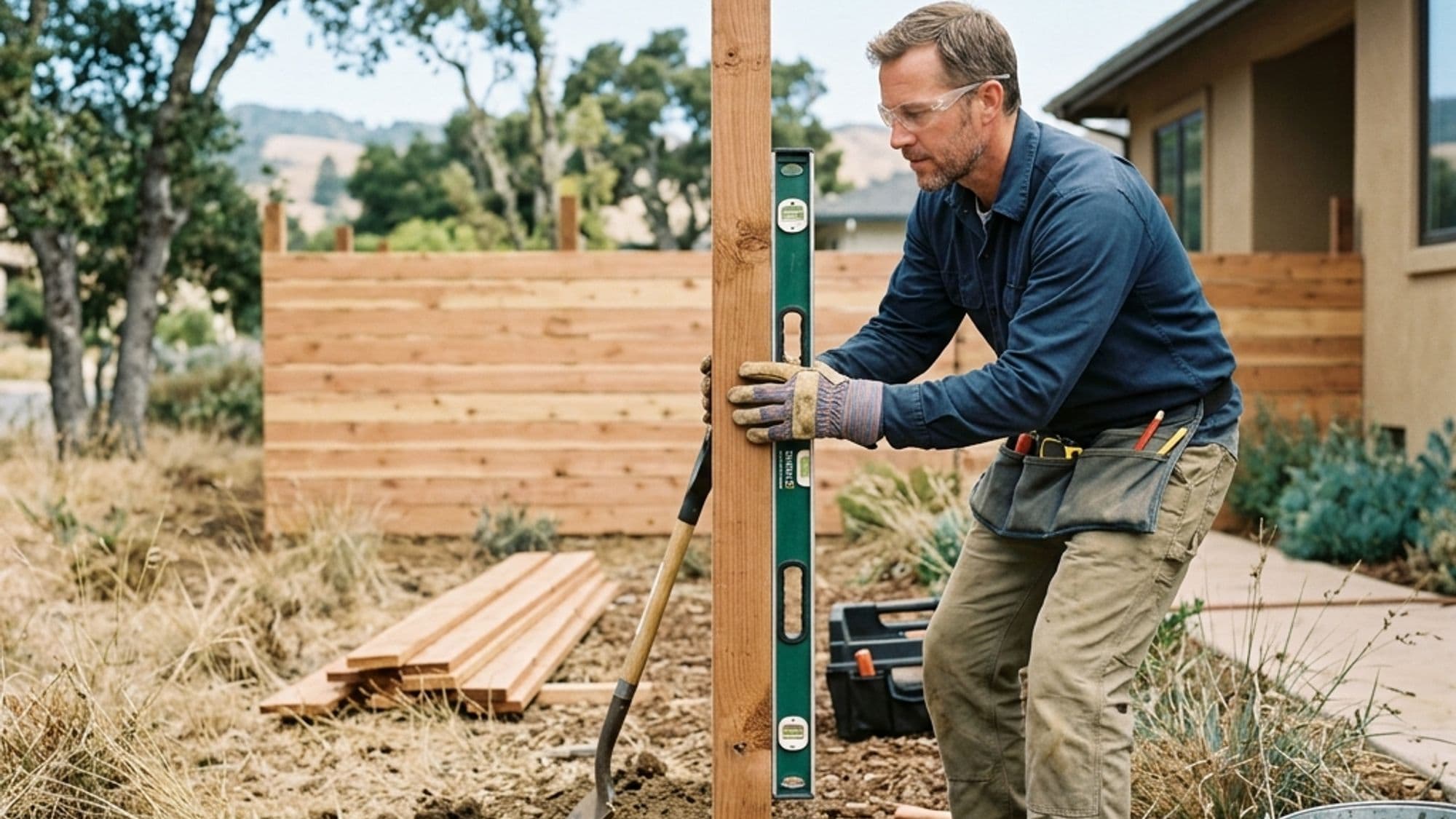
California C-13 Fencing Contractor License: Scope, Verification, and Permit vs. License
The C-13 license is the California classification for fencing contractors: fences, gates, railings, guardrails, and backstops. Any fencing job where labor, materials, and all other items total $1,000 or more must be done by a licensed contractor. A contractor's license is not the same as a building permit: many cities require a permit for fences over six to seven feet, which is separate from the C-13.
Verified against CSLB on · reflects current CSLB rules and California law.
Summary — key takeaways
- C-13 is the CSLB classification for fencing contractors.
- It covers fences, gates, railings, guardrails, and backstops, but excludes masonry walls (that's C-29).
- Fencing overlaps C-23 (ornamental iron) and D-28 (automatic gates).
- A license is not a permit: many cities require a permit for fences over six to seven feet.
- Fencing work of $1,000+ (labor, materials, and all other items) requires a licensed contractor (AB 2622, 2025).
What a C-13 fencing license permits
The C-13 classification covers building and installing fences, gates, railings, guardrails, and backstops of wood, vinyl, chain-link, or metal: the enclosure trades.
It excludes masonry walls, which are C-29. It can overlap C-23 (ornamental iron railings and gates) and the D-28 doors-and-gates specialty (automatic and access-control gates), so for an iron railing or a motorized gate, confirm the contractor's classifications match.
Permit vs. license: they're not the same
A contractor's license is the credential to do the work; a building permit is the city's approval for a specific project. They're different things, and conflating them is the most common fence confusion. Many California cities require a permit for fences above a height threshold (often six or seven feet), regardless of who builds it.
So a fence project can need both: an Active C-13 contractor and a city permit. Confirm who is pulling the permit (a licensed contractor pulls it in their own name) and that the height complies with local rules.
What fencing work legally requires a licensed contractor
Any project where labor, materials, and all other items total $1,000 or more must be performed by a CSLB-licensed contractor. The threshold rose from $500 to $1,000 on January 1, 2025 under Assembly Bill 2622 (Business & Professions Code §7048). Below $1,000, a narrow minor-work exemption can apply only if the job is casual, minor, and standalone (not part of a larger project), requires no building permit of any kind, no one is employed on the job, and any advertising discloses that the person is not licensed.
A short run of fence under $1,000 in labor, materials, and all other items can be unlicensed, with disclosure. A full perimeter fence is well over the threshold and should go to an Active C-13.
How to verify a C-13 fencing contractor
Confirm the license is Active and the C-13 classification is listed, either on the CSLB "Check a License" tool or on the contractor's profile in this directory. Match the license to the business you're hiring. Check that the $25,000 contractor bond is on file (Business & Professions Code §7071.6) and that workers' compensation coverage, or a valid exemption, is shown.
Browse Active C-13 fencing contractors by city in the California fencing directory and see each one's dated CSLB status before you hire.
The fencing workers' compensation rule
A fencing contractor must carry workers' compensation insurance for any employees. A contractor that genuinely works alone can currently file a no-employee exemption, so the CSLB record may show an exemption rather than a policy: confirm one or the other before you hire. Since January 1, 2026 (SB 291), a licensee caught employing workers without coverage faces minimum penalties of $10,000 per violation for a sole owner and $20,000 per violation for a partnership, corporation, or LLC, and cannot renew without current coverage.
Senate Bill 1455 will extend that requirement to every CSLB licensee, regardless of employees, on January 1, 2028, with CSLB's exemption-verification process due by January 1, 2027. Five high-risk classifications already carry no exemption at all, C-8 (concrete), C-20 (HVAC), C-22 (asbestos abatement), C-39 (roofing), and C-61/D-49 (tree service), and must hold coverage regardless of employees.
Frequently asked questions
Do fence contractors need a license in California?
Any fencing job of $1,000 or more in labor, materials, and all other items must be done by a CSLB-licensed C-13 contractor. Smaller minor work can be unlicensed only with disclosure.
Do you need a permit to build a fence in California?
Often, yes: many cities require a building permit for fences above a height threshold (frequently six or seven feet). A permit is separate from the contractor's C-13 license; a project can need both.
What are the red flags when choosing a fence contractor in California?
An unverifiable or inactive license, a name that doesn't match the CSLB record, a large cash-only deposit, and no written contract. Verify the C-13 first, then confirm the permit and bond.
What license does a fence installer need in California?
A C-13 fencing classification. For an ornamental-iron railing the work can fall under C-23, and for an automatic gate under D-28: match the contractor's classifications to the job.
Verify a contractor
Related guides and questions
- What is the $25,000 California contractor bond?
- Licensed vs. bonded vs. insured: what's the difference?
- What are the red flags when hiring a contractor?
- Licensed vs. unlicensed contractor: what work needs a license in California
- California C-29 masonry contractor license guide
- Do California contractors need workers' compensation insurance?